Roofing Guide
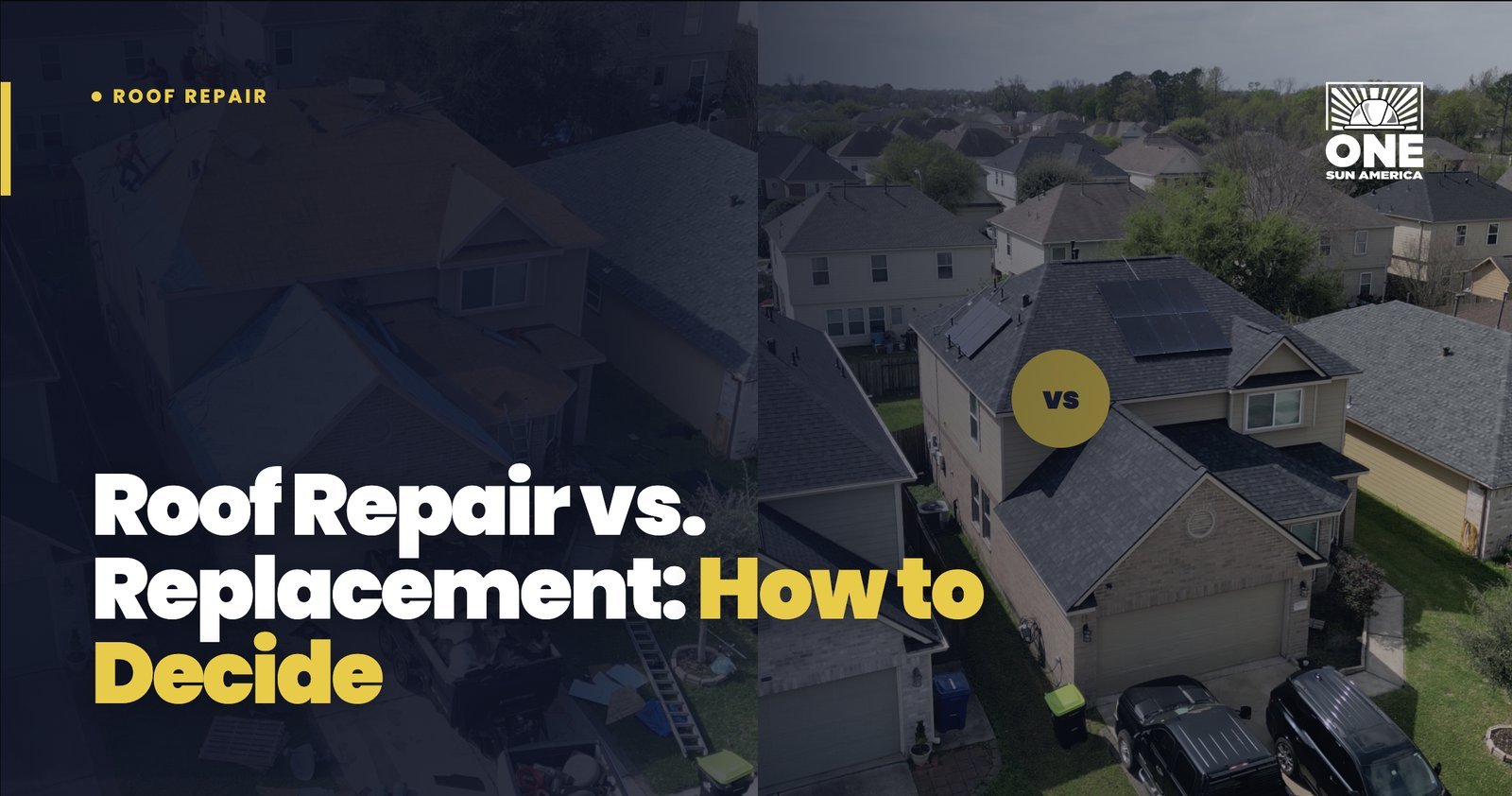
Roof Repair vs. Full Replacement: How to Decide
📅 April 1, 2026
👁 One Sun America Team
⏱ 8 min read
Last Updated: April 1, 2026
After a storm, a roofing contractor comes to your door and says you need a full replacement. Another one says you only need repairs. A third one says something different entirely. How do you know who to believe?
This is one of the most common dilemmas Houston homeowners face — and one where the stakes are real. A full roof replacement in Houston typically runs $10,000 to $18,000. A repair might cost $500 to $3,000. The difference matters. This guide will help you understand how legitimate contractors think about this decision, and how to protect yourself from being oversold.
The repair vs. replacement decision comes down to three factors that contractors, adjusters, and engineers evaluate:
These three factors interact. A 10-year-old roof with 15% damage is a strong repair candidate. A 20-year-old roof with 15% damage may still be a replacement candidate — because the remaining 85% of the roof is likely to fail within the next 3-5 years anyway.
The clearest case for repair is localized damage from a specific, identifiable cause. A single tree branch that fell and broke 40 shingles. A pipe boot collar that cracked and caused a leak in one spot. A section of ridge cap blown off by wind. These are surgical problems with surgical solutions — repairing them properly costs a fraction of a replacement and is entirely appropriate.
The harder cases are roofs with mixed conditions: some areas with significant storm damage and other areas with age-related wear. This is where Houston's climate compounds the problem. A 14-year-old architectural shingle roof in Houston may have 3 more years of life in good sections — but those good sections are also carrying significant UV and heat fatigue. Repairing the storm-damaged section may be technically possible, but you're buying 2-3 years before the whole roof needs replacement anyway.
In these gray-zone cases, a reputable contractor should lay out both options with honest numbers: repair cost now vs. replacement cost now vs. repair cost now plus replacement cost in 2-3 years. The total-cost math often favors replacement.
You may hear contractors and adjusters reference the "50% rule." Here's what it actually means in practice:
In Texas, some building codes and insurance policies contain provisions that require a full replacement when repair costs exceed a certain percentage of replacement cost — commonly 50%. The reasoning: if repairing the damaged area costs more than half of replacing the whole roof, you're better off replacing it entirely and getting a warrantied new roof in the process.
If your insurer applies ACV (Actual Cash Value) depreciation to your claim, the math changes again. A 15-year-old roof may have a depreciated value so low that your claim payout barely covers materials — which is one reason adjusters sometimes push for replacement on older roofs even with moderate damage.
After major Houston storms, a wave of out-of-town contractors arrives looking for quick jobs. Some use high-pressure tactics and push for replacements on every house they inspect. Here's how to protect yourself:
Always get at least two estimates, ideally three. Not verbal ballparks — written, itemized estimates that specify: the damaged area in square footage (or as a percentage), what material will be used, whether the deck will be inspected and what the additional cost would be if deck replacement is needed, and the warranty terms.
A legitimate contractor will photograph the damage before doing any work. Ask to see the photos. If a contractor says you need a full replacement but can't show you photos of widespread damage across the roof surface, be skeptical. You're entitled to see the evidence that's driving the recommendation.
Before signing any contract, understand the exact scope. A repair should tell you: which sections, how many squares (a "square" = 100 sq ft), what materials. A replacement should tell you: total squares, material spec (manufacturer, product line, color), what happens to the decking, ventilation plan, and warranty terms (both on materials and workmanship).
Understanding how the insurance adjuster thinks about this decision gives you an advantage when navigating a claim.
Adjusters use software (primarily Xactimate) to price repairs and replacements based on square footage, material type, and labor rates in your market. They're looking at:
Having a contractor who understands Xactimate and the claims process is valuable — they can document damage in a way that matches how adjusters think, which results in more accurate (and often more complete) claim settlements.
Here's a realistic picture of what these options cost in the Houston market as of 2026:
The 50% rule refers to a point at which the cost of repairing a roof exceeds 50% of the cost of replacing it. At that point, most insurance adjusters and contractors will recommend replacement. Some Texas policies have specific language about this threshold — check your policy's dwelling provisions carefully.
Unfortunately, yes — some contractors push for replacements because the job is larger and more profitable. The best protection is to get two or three written estimates, ask each contractor to specify the damaged area as a percentage of total roof area, and request photos of the actual damage. A reputable contractor will show you the damage and explain exactly why a full replacement is or isn't warranted.
Minor repairs in Houston typically run $300–$800. Moderate repairs run $800–$2,500. A full replacement on a typical Houston home (1,800–2,500 sq ft) runs $9,000–$17,000 depending on material choice.
Después de una tormenta, llega un contratista y dice que necesitas reemplazar todo el techo. Otro dice que solo necesitas reparaciones. Un tercero dice algo diferente. ¿Cómo sabes a quién creerle?
Este es uno de los dilemas más comunes que enfrentan los propietarios de Houston. Un reemplazo completo en Houston típicamente cuesta de $9,000 a $17,000. Una reparación podría costar $500 a $3,000. Esta guía te ayudará a entender cómo los contratistas legítimos piensan sobre esta decisión.
La reparación es la opción correcta cuando:
Después de tormentas grandes en Houston, llegan muchos contratistas foráneos usando tácticas de alta presión. Para protegerte:
En One Sun America te damos una evaluación honesta sin presión. Llamanos para una inspección gratuita.